Beyond 3D Printing: How 5-Axis CNC Machining Solves the Toughest Challenges in Modern Prototyping and Production

Introduction
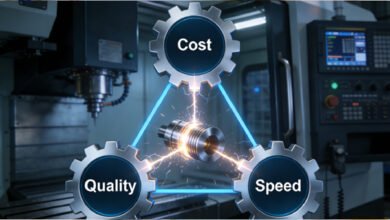
In product development, engineers face a persistent dilemma: 3D printing excels at rapid creation of complex shapes, but often falls short in strength, precision, surface finish, and scalability. Meanwhile, traditional 3-axis CNC machining is strong and precise, but struggles with intricate contours, deep cavities, and multi-sided features, leading to multiple setups, lost accuracy, and soaring costs. This forces teams to compromise, sacrificing either design integrity or economic viability.
The core issue is a fundamental limitation in kinematic freedom. Existing methods cannot simultaneously deliver high complexity and high precision, creating a “pick one” scenario. This article explains how 5-axis CNC machining fundamentally resolves this conflict. By enabling tool movement from virtually any spatial angle, it unlocks a new paradigm for manufacturing complex, high-value parts, turning ambitious designs into reality without compromise.
How Does 5-Axis CNC Machining Achieve “Impossible” Geometries in a Single Setup?
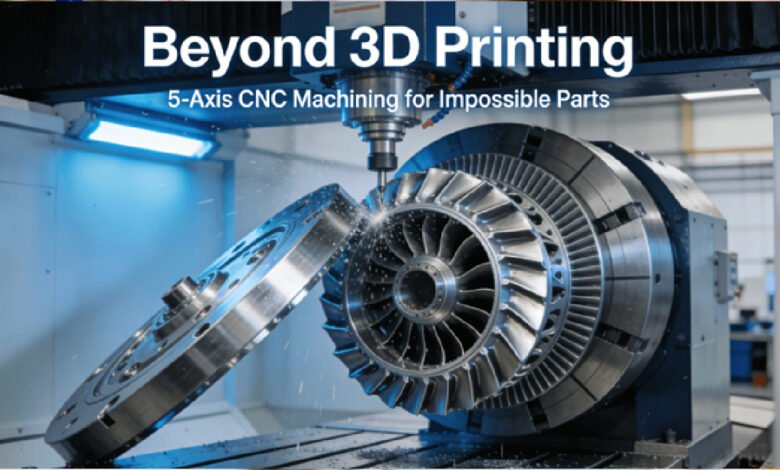
5-axis CNC machining breaks the constraints of linear motion by introducing two rotational axes to the standard three linear ones. This allows the cutting tool to approach the workpiece from any direction. Consider a blisk (bladed disk) for a turbocharger. On a 3-axis machine, the complex undercuts and contoured backsides of the blades are inaccessible, requiring multiple intricate fixtures and operations. A 5-axis machine, by continuously adjusting the tool’s orientation, can machine such features in a single, continuous setup.
1. The Mechanics of Tool Orientation and Vector Control
The technology’s power lies in “tool axis vector control.” Beyond just positioning the tool tip, the machine and its CAM software precisely control the spatial orientation of the entire tool. This enables flank or side milling, where the efficient side cutting edge of the tool is used to sweep across a surface, rather than inefficiently “scrubbing” with the tip of a ball-nose cutter. This is essential for machining efficient, high-quality free-form surfaceson everything from impellers to prosthetics.
2. The Unrivaled Precision of a Single Datum
Eliminating multiple setups eliminates the primary source of error in complex part manufacturing. Every time a part is re-clamped, a new potential for misalignment is introduced. 5-axis simultaneous machining locks the workpiece to a single, unchanging coordinate system for the entire operation. This ensures that all features — holes, pockets, and surfaces on different sides — are machined in perfect geometric relationship to one another, guaranteeing critical concentricity, perpendicularity, and profile tolerances that define true precision engineering.
3. Enabling a New Class of Integrated Designs
Therefore, 5-axis capability is an enabler of monocoque and topology-optimized structures. It allows designers to consolidate assemblies of multiple parts into single, stronger, lighter components. It makes manufacturable the organic, biomimetic, and highly complex geometries that are optimal for fluid dynamics, structural efficiency, or ergonomics. This ability to produce previously “impossible” parts as a single piece is the cornerstone of innovation in advanced manufacturing.
What Are the Three Main Types of 5-Axis Machines and When to Use Which?
Not all 5-axis machines are the same. The choice of configuration — head, table, or hybrid — directly impacts the machine’s capabilities, precision, and optimal application. Understanding these differences is key to selecting the right tool for the job. The three primary architectures cater to different scales, materials, and precision requirements, shaping the landscape of modern machining.
1. Head/Head (Tilting Spindle) Machines: For Large, Heavy Workpieces
In this configuration, the spindle itself tilts and rotates, while the table typically moves in linear axes. This is ideal for large, heavy parts like aircraft structural components or large molds, as the workpiece remains stationary on the massive, rigid table. The tilting spindle provides the necessary angular access. The primary engineering consideration is maintaining rigidity and dynamic accuracy in the moving, heavy spindle head, which is a feat of advanced mechanical design.
2. Table/Table (Trunnion) Machines: For Small, High-Precision Parts
Here, the workpiece is mounted on a tilting rotary table, and the spindle only performs linear movements. This configuration is renowned for extremely high accuracy, as the workpiece is manipulated on a precise rotary axis near the machine’s base. It is the go-to choice for small, intricate components in optics, medical devices, and fine mechanics, where micron-level precision and superb surface finishare paramount. The stability of the fixed spindle contributes to this exceptional accuracy.
3. Hybrid (Head/Table) Machines: The Ultimate in Flexibility
Hybrid machines combine a tilting spindle with a rotary table, offering maximum flexibility. This allows for machining very tall parts (using the table’s tilt) or for positioning a part to machine the backside without re-fixturing. It is excellent for job shops and R&D environments that face a wide variety of part geometries and sizes. A deeper technical dive into the nuances of these systems is essential for making informed decisions, and resources detailing the capabilities of 5-axis CNC machining servicescan provide crucial insights for selecting the optimal technology for specific project challenges.
Beyond Speed: What Are the True Disruptive Advantages Over 3-Axis CNC?
While reducing setup time is a clear benefit, the most profound advantages of 5-axis machining are qualitative, transforming part functionality, quality, and total cost. The first is a leap in geometric fidelity. By maintaining one perfect datum, 5-axis machining ensures that form, profile, and positional tolerances are held to levels unattainable with multiple 3-axis setups, where each re-clamping introduces a new variable. This is the foundation of Engineering Excellencein assemblies where fit and alignment are critical.
- Superior Surface Integrity and Mechanical Performance: 5-axis machining enables optimal cutting conditionsat all times. By maintaining a constant, favorable engagement angle between the tool and the curved surface, it produces a more uniform, higher-quality finish with less residual stress. This directly translates to improved fatigue life, wear resistance, and corrosion performance of the component. The ability to use shorter, more rigid tools also reduces vibration, further enhancing surface finish and allowing for more aggressive material removal in tough alloys, redefining the standard for manufacturing processes.
- Holistic Cost Optimization and Risk Reduction: The financial case extends far beyond the machine’s hourly rate. Consider the eliminated costs: multiple custom fixtures, dedicated CMM programming for each setup, labor for part handling and requalification, and the scrap generated from accumulated misalignment errors. Furthermore, the ability to produce a part as a single component eliminates assembly costs and potential failure points. For complex, high-value parts, the total cost of ownershipof a 5-axis approach often proves lower, while simultaneously delivering a superior product with faster time-to-market.
- A Paradigm Shift in Design and Production: Therefore, the advantage is systemic. It shifts manufacturing from a series of disconnected, error-prone steps to a cohesive, sculptural process. This allows for designs that are lighter, stronger, and more efficient. It reduces supply chain complexity by consolidating parts. Industry analysis consistently shows that reducing part count and setupsis a primary driver for quality and cost improvement, making 5-axis technology a cornerstone of competitive industrial solutionsin advanced sectors.
Which Industries Are Driving the Demand for 5-Axis Machining Capabilities?
The adoption of 5-axis machining is being propelled by industries where performance, precision, and material efficiency are non-negotiable. In aerospace and defense, it is essential for machining monolithic structural components, turbine blades, and engine casings from titanium and nickel superalloys. The technology enables dramatic weight reduction through topology optimizationand the creation of complex internal cooling channels, directly impacting fuel efficiency and thrust.
1. Medical and Life Sciences: Precision for the Human Body
The medical industry relies on 5-axis machining for biocompatible, patient-specific solutions. It machines the complex, organic surfaces of orthopedic implants (knees, hips, spinal cages) from materials like titanium and cobalt-chrome. It also produces intricate surgical instruments, robotic surgery components, and custom prosthetics with the micron-level accuracy and flawless surface finishesrequired for patient safety and surgical success, representing the pinnacle of Tech Innovationsin medtech.
2. Automotive, Energy, and Beyond
High-performance automotive and motorsport use 5-axis machining for cylinder heads, suspension components, and aerodynamic elements. The energy sector employs it for turbine blades, fuel system components, and molds for composite parts. Even consumer electronics leverage it for unibody enclosures and complex camera housings. The common thread is the need to machine high-integrity parts from advanced materialswith geometries that defy conventional methods, making 5-axis capability a key strategic asset.
3. The Engine of Technological Progress
Thus, 5-axis machining is not just a manufacturing tool; it is an enabler of sector-wide advancement. It allows these industries to push the boundaries of what’s possible, creating products that are lighter, stronger, more efficient, and more reliable. The demand for such complex part machining with 5-axis technologywill only grow as the relentless pursuit of performance and miniaturization continues across all fields of industrial technology.
Is Investing in 5-Axis Machining Justified? A Total Cost of Ownership Perspective
The decision to invest in 5-axis technology must be evaluated through a comprehensive total cost of ownership (TCO) lens, not just the purchase price of the machine. The upfront capital expenditure is significant, covering the machine itself, advanced CAM software, and specialized tooling. There are also ongoing costs for highly skilled programmers and operators, maintenance, and calibration. However, this is only one side of the equation. The cost savings and value creation enabled by 5-axis machining are often transformative.
- Quantifying the Hidden Savings: The most substantial savings are often indirect. A single setup eliminates the costof designing, manufacturing, and storing multiple complex fixtures. It drastically reduces machine idle time for part handling and requalification. Scrap and rework rates plummet because the primary source of error (multiple datums) is removed. Furthermore, the ability to use more efficient toolpaths and shorter tools reduces cycle times and extends tool life. For a shop producing complex parts, these savings can quickly offset the higher machine rate.
- The Value of New Capabilities and Market Access: Beyond cost avoidance, 5-axis machining creates new revenue opportunities. It allows a manufacturer to bid on and win high-margin work in aerospace, medical, and other advanced sectors that are inaccessible with 3-axis technology. It enables faster prototyping and product iteration, getting products to market sooner. The technology also future-proofs a business, allowing it to adapt to increasingly complex design demands. The return is measured not just in cost per part, but in business growth and competitiveness.
- The Strategic Partnership Alternative: For many organizations, the most rational path is strategic partnership, not capital investment. The high cost and rapid obsolescence of technology, coupled with the scarcity of expertise, make in-house ownership prohibitive for many. This is where partnering with established 5-axis CNC machining services manufacturersbecomes a powerful strategy. It provides immediate access to world-class capability, expert engineering support, and scalable capacity without the capital outlay and operational risk, allowing companies to focus on their core product innovation.
How to Vet a 5-Axis Machining Partner: Beyond the Machine Brochure?
Choosing a 5-axis machining partner is a critical technical and business decision. A rigorous evaluation must look beyond machine specifications to assess process mastery, quality culture, and collaborative capability. Start with technical and application depth. Review their portfolio for parts of similar complexity and material to yours. Ask specific questions about their approach to challenging features like deep cavities, thin walls, and undercuts. A true expert will discuss strategies for toolpath optimization, vibration damping, and thermal management, not just machine models.
1. Auditing the Quality Management System
The most reliable indicator of consistency is a certified, mature quality system. Require evidence of relevant certifications: AS9100D for aerospace, ISO 13485 for medical devices, IATF 16949 for automotive. These are not just certificates; they mandate a preventive, process-controlled approachto manufacturing. Ask to see examples of their process documentation, First Article Inspection Reports (FAIR), and Statistical Process Control (SPC) data. This proves their commitment to delivering predictable, high-quality results, not just hoping for them.
2. Evaluating Engineering Collaboration and Communication
The best partners act as an extension of your engineering team. During the quoting process, do they provide substantive, actionable Design for Manufacturability (DFM) feedback? Do they ask insightful questions about the part’s function to suggest optimizations? Assess their project management and communication protocols. Is there a clear point of contact and regular update process? A partner that engages proactively in problem-solvingwill de-risk your project and add significant value beyond simple part fabrication.
3. Making a Strategic Sourcing Decision
Therefore, the vetting process should culminate in selecting a true partner, not just a vendor. Look for a combination of advanced technical capability, systemic quality assurance, and a collaborative culture. This holistic assessment ensures you choose a partner who can reliably produce your complex parts, contribute to their design optimization, and support your product’s success from prototype through production. This approach transforms sourcing from a cost-centric activity into a strategic investment in your product’s quality and your own operational efficiency.
Conclusion
5-axis CNC machining represents a fundamental shift in manufacturing philosophy, liberating design from the constraints of traditional processes. It is the definitive solution for producing complex, high-precision, and high-value components that define modern innovation. By enabling single-setup machining of “impossible” geometries, it delivers unrivalled accuracy, superior surface integrity, and, when viewed holistically, compelling economic advantages. Successfully leveraging this technology — whether through investment or partnership — requires a deep understanding of its principles and a disciplined approach to evaluating the capabilities of those who wield it. In the race to develop the next generation of advanced products, mastery of 5-axis machining is not just an advantage; it is a necessity.
FAQs
Q: What’s the biggest misconception about 5-axis machining?
A:The biggest misconception is that it’s primarily about speed. Its paramount advantage is geometric accuracy and capability. Maintaining a single workpiece datum and machining from optimal angles produces parts with superior dimensional integrity and surface finishes, enabling previously unmanufacturable monolithic designsthat reduce part count and assembly risk.
Q: For a startup with a complex prototype, is 5-axis machining cost-prohibitive?
A:Not necessarily. Partnering with an experienced 5-axis service provider makes it accessible. The “single-setup” benefit drastically reduces fixture and labor costs. For a highly complex prototype, the total cost can be competitive with or lower than 3-axis when factoring in multiple fixtures, setups, and alignment errors. Early DFM consultationis key to cost optimization.
Q: How do I prepare my CAD model for a 5-axis machining quote?
A:Provide a clean 3D model in STEP or IGES format. Include all critical dimensions, tolerances (GD&T), surface finish requirements, material specs, and post-processing needs. A clear 2D drawing is invaluable. Complete informationensures an accurate quote and actionable DFM feedback, streamlining the entire process.
Q: Can 5-axis machines handle all the materials that 3-axis machines can?
A:Yes, often more effectively. 5-axis machines are built robustly for all standard materials. Their advantage shines with difficult alloys like titanium or Inconel. The ability to use shorter, more rigid tools and maintain optimal cutting engagement can lead to better tool life, improved surface integrity, and faster metal removal compared to 3-axis methods.
Q: What is the most critical factor for success in a 5-axis machining project?
A:Early collaboration and communication between design and manufacturing engineers. Involving the machining partner during the design phase for DFM unlocks the full potential of 5-axis, allowing for design optimizations that improve machinability, reduce cost, and enhance performance. Choosing a partner with strong application engineering supportis as crucial as the machine technology itself.
Author Bio
This article draws on the extensive, practical expertise of precision manufacturing specialists at the forefront of advanced machining technology. The insights connect the engineering principles of 5-axis machining with real-world application challenges and solutions. LS Manufacturingis a certified precision manufacturing partner that employs advanced 5-axis CNC systems, rigorous quality management, and collaborative engineering to transform intricate designs into reliable, high-performance components for the most demanding industries.